✅ Brain Training For Dogs Where To Buy?


I attempted in this video to clarify the main doubts that help everyone who is searching for all the facts regarding the Brain Training For Dogs. So if you do not wish to regret, I urge you to stay in the duration of the video in order to learn all the important points.

✅ What is Brain Training for Dogs all for? This book, Brain Training for Dogs, teaches you the best techniques for correcting your dog's behavior to eliminate bad habits such as barking, biting or chewing while improving his obedience. ✅ Does Brain Training for Dogs Work? Yes, the method has been proven to be beneficial after many studies and tests on canine behavior and after a number of studies, it has been concluded that this method works well and helps make dogs' behavior significantly better. ✅ Brain Training for Dogs Benefits:
  • Eliminate problematic traits such as aggression and excessive barking
  • Your dog behaved more comfortably and obediently
  • The best bond between the two of you.
✅ Brain training for dogs, is it just worth the cost? Yes, it is a unique method that enables anyone to get control over behavior and to have a better behaved dog without resorting to violence and force, as with other methods. ✅ Does brain training for dogs work well? Yes, brain training for dogs has a good feedback and has helped many people. ✅ Brain Training For Dogs Where To Buy? Brain Training For Dogs sold only by the official brand on its official site, since other sites may sell unofficial products, and in order to ensure that this suits your needs, I typed in the link below in the description, so you can easily navigate there.

Fireweed Woodshop returns, bringing woodworking to women and nonbinary people


Fireweed Woodshop returns, bringing woodworking to women and nonbinary people

A person demonstrates a wood cutting technique
Students and instructors talk during a class at Fireweed Community Woodshop’s Wednesday in their new brick-and-mortar space.
Nicole Neri for MPR News

Share

A Minneapolis woodshop dedicated to marginalized genders is bringing women and nonbinary people into a craft that is often viewed as masculine. Fireweed Community Woodshop reopened recently after shuttering during the pandemic. MPR News reporter Grace Birnstengel talks with guest host Tim Nelson about the Fireweed and their mission.

Click the audio player above to listen to the full episode.

Subscribe to the Minnesota Now podcast on Apple PodcastsGoogle PodcastsSpotify or wherever you get your podcasts.

We attempt to make transcripts for Minnesota Now available the next business day after a broadcast. When ready they will appear here.

The World's Largest Collection of 16000 Woodworking Plans!

Audio transcript

INTERVIEWER: So woodworkers out there, you know the word of the woodshop.

[WOOD CUTTING SOUND]

There's the smell of it. The sound of it. There's nothing like it. But not everyone is traditionally welcome in woodshop. A Minneapolis shop dedicated to marginalized genders is changing that.

Fireweed Community Woodshop reopened last weekend after shuttering during the pandemic. MPR News reporter, Grace Birnstengel, is here to tell us more. Welcome back to the show, Grace.

GRACE BIRNSTENGEL: Thanks for having me, Tim.

TIM: So what got you in there?

GRACE BIRNSTENGEL: So I live in South Minneapolis, and I was familiar with the shop back when it was called Women's Woodshop. I knew it was really popular. And to my knowledge, it was pretty unique. You don't actually have to have any experience to take classes there.

And I was pretty bummed when they lost their first base in a few months of the pandemic because I knew it was really popular. And a couple of people mentioned to me that it was reopening, and I have several friends who work in the trades and are not men. So I know from them how masculine that world can be and, therefore, how important spaces like these are.

TIM: Talked a little bit about the trades. Not all of them are the same, but they're woodworking and carpentry. What's the difference here.

GRACE BIRNSTENGEL: Yeah. So they're not the same, but there's an overlap in the skills. Carpentry is constructing houses or buildings, or other structures, and then putting the appliances in and stuff. And woodworking is making things out of wood.

TIM: And what kind of things are they making at Fireweed? What are they working on down there?

GRACE BIRNSTENGEL: Yes, so they generally have three types of classes. They have furniture classes where people are making tables or stools. They have craft classes. At Fireweed, they make baskets, wooden boxes, bowls, wooden toys, and then there are really practical classes that are geared toward renovation.

There are a lot of first-time home buyers that go to Fireweed for classes. And one is called Be Your Own Handy Person. There's also a Power Tools 101. And then, I also want to add that there's a sliding scale for payment. And most classes also have two seats saved for people of color to take them for free.

TIM: And it's not just reopening. It's getting a little bigger here. Location, I think, got much larger. Right? What are they doing with it?

GRACE BIRNSTENGEL: Yeah. So in their old space in the Standish neighborhood, all their tools were on wheels, and they had to be rearranged constantly because it was so small. And this space is triple the size. It's also in a more central location.

It's right off the Franklin Avenue Bridge in Prospect Park. And it's really accessible by bus and bike, which I know is something that was important to them for the new location.

I was there the other day. And it's a really beautiful space that has huge windows. It used to be an upholstery shop. So yeah, the front of the shop has all these big windows.

And you can see the bridge. And there was the sunset. It was one of those pink sunsets the other day that we've been seeing. So it's a great spot.

TIM: Much better than the shop at Coon Rapids High School where I went. The cinder block bunker where I learned to do woodwork.

GRACE BIRNSTENGEL: I hope so.

TIM: But this place is doing quite well. I understand it was very popular before the pandemic.

GRACE BIRNSTENGEL: Yeah. They had, I was told, 1,000 students every year, usually, and about 100 classes and 40ish instructors. Mostly, I should say, women and non-binary instructors.

TIM: And I believe you said you were at a table making class on Wednesday. Are these stationary tools? Hand tools? What's actually going on there?

GRACE BIRNSTENGEL: Yeah, so there were seven students. It's a mix of stationary tools and hand tools. Like, half and half, I would say. The students were in their third week of the class. And they were milling the wood they're going to use for their tables, which means, to my understanding, using tools to shape the lumber into wood you can-- or excuse me.

Shape the wood into lumber-- that's the way it goes-- that you can use for tables. It was really chill. Just people, kind of-- they were confident. Confidently using power saws. Helping each other out. It was a great environment.

And I was really curious what types of people were drawn to that space. And the founder, Jess Hirsch, she said that there's four different categories of people that tend to take classes. It's friends that want to take a class together. Not necessarily even woodworking, but that's what they landed on. Sometimes people want to switch careers and get into the trade, so they take a class there.

Woodworking class in high school. Like you mentioned Tim, a lot of the times, young girls or non-binary people feel unwelcome in those classes or maybe pushed out because they're pretty masculine, like I said earlier. And then, there are also people who say they have access to the tools from family members, but were never taught how to use them and want to take advantage of that.

TIM: So I've been at a couple of these places. The Minneapolis Tool Library, I've been to their shop. It's kind of nice. What makes this place different? What's what brings folks to this one?

GRACE BIRNSTENGEL: Well, I think it's the safety and the support that they can get in that environment and knowing that you can come in, no skills needed. And I actually talked to one of the co-chairs of the board there who also teaches spoon carving for people of color.

They have classes that are just for people of color. And then, she also was taking the class on Wednesday. So here is Vanessa Walton talking about why this space is so important.

VANESSA WALTON: I am really thankful for this space. I'm thankful for our community. I really want to welcome people to come here. We certainly are geared towards women and non-binary people, but we have classes that are open to all genders. And we try to create spaces that are specifically also for BIPOC folks too so they can learn from instructors who represent their communities.

And I think, yeah, I just want to make it clear that we are open, and we are here, and we welcome all people. And so we really want you to come down and take a class. Check out our space.

GRACE BIRNSTENGEL: That's awesome.

VANESSA WALTON: Yeah.

TIM: Spoon carving. An art after my grandmother's heart. You know, the pandemic was really hard on a lot of these places that depended on a lot of people to support them, places that help people come together. How does this place make community beyond its walls?

GRACE BIRNSTENGEL: Yeah, so they didn't actually completely shut down during the pandemic. They switched to doing some Zoom classes where they could. But, obviously, Zoom is not an ideal environment for learning how to do woodworking. And most people don't have power saws at home.

TIM: Hard to be hands-on on the laptop there.

GRACE BIRNSTENGEL: Exactly. So I think it's really community building and that people are together, have actual access to the tools, and can give each other feedback on their projects. And I asked the founder who I mentioned earlier, Jess Hirsch, to tell me more about what you just asked, and here is her on that.

JESS HIRSCH: It is so supportive. It's like, people will clap for you after you use the table saw for the first time. People feel-- If you have inhibitions about a tool, you can ask for multiple demos. We can do dry runs without the machine on.

It's never a space to judge or watch each other in a negative way. We're just learning from each other. And that nurturing space is really cultivated by our instructors and, pretty naturally, by other students. It's a really supportive place. And I think just due to the goals of the people coming to the shop, I think it maintains that throughout.

TIM: You talked about power tools here. Do people have to have experience to go to this place?

GRACE BIRNSTENGEL: No, they don't. No experience is necessary for most of the classes. I think, some of them, you're required to take Power Tools 101 beforehand.

But most of them, you don't have to have experience. And everybody there is really nice, so don't be intimidated if you want to take a class. And their website is fireweedwoodshop.org, which has a list of their roster of classes.

TIM: And that's Grace Birnstengel, a reporter here at Minnesota Public Radio News. Thanks for sharing.


The gift of woodworking


Special to ICT

Thomas Howes’ traditional wooden artwork is not meant to be on the mantel of the fireplace or on the wall collecting dust.

Howes creates ornate wooden pieces, crafted from various trees throughout the Minnesota northlands that not only reflect tribal culture, but that are also fully functioning pieces. This includes a series of cradleboards, or dikinaagan, that he has been creating.

“Over the years I’ve learned to make things from the tree nation to care for my family and community,” Thomas Howes said. Howes also makes lacrosse sticks as well as knockers, clan markers for traditional burials, drum sticks, drum stand legs and snowshoes.

This type of artwork requires steam-bending sticks and slats of wood.

Howes said he got his start making cradleboards just over 13 years ago

“My wife was pregnant with twins at the time and we were visiting a birchbark canoe building project at Fond du Lac,” Howes said. There, he met Red Cliff Ojibwe band citizen Marvin Defoe, who was leading the canoe build and who nudged Howes to make his twins a set of dikinaagan.

Like this story? Support our work with a $5 or $10 contribution today. Contribute to the nonprofit ICT.

The dikinaagan was a team effort. With help from other tribal members finding the right types of old-growth cedar, ash tree and plane wood, as well as tapping into their bending techniques, Howes managed to create two new dikinaaginanak.

“After that I sporadically was asked to make dikinaaganan for people and even held one large workshop to teach techniques in the Fond du Lac community,” Howes said. “I grew up with a dikinaagan in our home that my parents got from a man near Grand Portage and I always found the bends beautiful so I made a clone of its shape for all the ones I make to this day.”

Thomas Howes, Eagle Clan from Fond du Lac Band of Lake Superior Chippewa, his wife Nashay, from the Turtle Mountain Band of Chippewa, and family live in the historic village of Fond du Lac southwest of Duluth, Minnesota. He works for the Fond du Lac Band as the Natural Resources Program Manager.

In addition to the cradleboards, Howes also makes lacrosse sticks. He has never played the game, but attended a match that included the Twin Cities Native Lacrosse team, which was visiting Fond du Lac to learn about forest management. Howes said he quickly fell in love with lacrosse.

“In our area and particularly Fond du Lac there were no players and certainly no stick makers,” he said. “I felt that it would be good for our community to revive the play of baaga’adowewin and to expedite that we needed sticks.”

Howes’ Native core values defined how he made his woodworking projects, and how he and others worked and used them in the traditional way they were to be used.

The World's Largest Collection of 16000 Woodworking Plans!

20 Woodworking Projects That Sell Like Hot Cake


20 Woodworking Projects That Sell Like Hot Cake

Make money out of your hobby and skills. Learn about the woodworking projects that sell over here in this article. Most of them are quite easy to make.

20 Woodworking Projects

A really fun way of making money is to take up projects in woodworking. The possibilities of what you can do with wood are enormous.

Here, we will tell you about the woodworking projects that sell well so that you can utilize them to bank some money. Make money by doing these 20 woodworking projects listed in this section. These products have high demand and are comparatively easy to make:

>>> Get Instant Access To 16,000 Woodworking Projects Now <<<

  1. Book Shelves

People will never get tired of buying and reading books. Most avid readers have a small section in their house, usually just for their books. This could be an entire room dedicated to it or even a small bookshelf.

Making these square shelves are quite easy, and they are actually quite inexpensive. Their versatilityis great, and you could put decorative pieces instead of books;also,the overall look of your house will be elevated. Moreover, you willbe able to customize the size according to your needs.

  1. Photo Frames

Hanging pictures on the walls of your home brings a feeling of nostalgia for the good old days or a special memory when you glance at them. Making photo frames is not difficult at all and is the perfect thing to do for those who are just starting with woodworking projects.

Not just that, taking up a project like this will be very cheap for you, and there is a high demand for these. And you can make good picture frames with a simple toolbox.

  1. Customized Letters or Alphabets

Nowadays, it is common to see customized letters or sentences that hold sentimental significance in people’s rooms. Since this is in high demand, you may want to learn how to create these letters. It is simple but can make you a good amount of money if you do it nicely.

Woodworkers Are Showing Off the Incredible Things They Build on the Woodworking Subreddit


Woodworkers Are Showing Off the Incredible Things They Build on the Woodworking Subreddit

Online communities can be a big help for your profession or hobby. These groups can offer support and guidance as well as lend their expertise from anywhere around the world. The subreddit r/woodworking is one of those places. With over 4 million members, the community is home to anyone creating furniture, toys, tools, and more whether they are entering woodworking as an enthusiast or a professional.

Many of the posts feature people sharing their amazing projects as part of a virtual show and tell. Some of the pieces are practical, like an elegant garden bench constructed in different colors of ash wood. “That's a thing of beauty,” one Redditor says. “I appreciate the way you have both the handrail curving downwards and the backrest curving outwards away from the chair. Such craftsmanship.” Other posts share works of art. A Redditor with the username PeasterBunny finished a kinetic sculpture and immediately went to the subreddit to share it in action. In a mesmerizing video, they crank a lever to move brass and walnut wood forms that then power an undulating acrylic piece that sits atop the structure. “Tremendous talent, there is woodworking and then there is art,” someone commented. “You sir are an artist.” 
The difference in posts showcases the breadth of work to be found in r/woodworking. But no matter what you create, you'll find a supportive community with a passion for building. 


Nancy Hiller, Who Broke a Glass Ceiling in Woodworking, Dies at 63


Nancy Hiller, Who Broke a Glass Ceiling in Woodworking, Dies at 63

One of the few women in her profession, she steadily built a quiet but forceful reputation as one of the best cabinetmakers in the country.

  • Nancy Hiller in 2018 with cabinets she built. She specialized in clean lines and minimal ornamentation.
Credit...via Hiller family

The World's Largest Collection of 16000 Woodworking Plans!Clay Risen

Nancy Hiller never planned on becoming one of America’s most renowned cabinetmakers and among just a handful of women in that male-dominated trade. She just needed a decent chair.

After studying at the University of Cambridge, Ms. Hiller, a native of Miami Beach, dropped out in 1978 and moved with her boyfriend to a small town in central England in search of work. She toiled in a metal-casting factory, but all they could afford was an unfurnished apartment. To save money, she decided to fill it herself, building her first tables and chairs from scavenged wood and scraps.

Her D.I.Y. period led her to trade school and later to a series of jobs with bespoke furniture workshops around England. After returning to the United States, she took similar positions in Vermont and Montana before settling down in Bloomington, Ind., where she opened her one-woman workshop, NR Hiller Design, in 1995.

From there, she steadily built a quiet but forceful reputation as one of the best woodworkers in the country, turning out custom, precisely built cabinets, side tables and whole kitchens for clients as far as New York and Chicago. The actor Nick Offerman, himself an accomplished woodworker and a member of Ms. Hiller’s legion of admirers, called her an “Obi-Wan Kenobi level master.”

Ms. Hiller died on Aug. 29 at her home in Bloomington. She was 63. Her husband, Mark Longacre, said the cause was pancreatic cancer.

Inspired by the Arts and Crafts movement of the late 19th and early 20th centuries, Ms. Hiller specialized in clean lines, minimal ornament and a truth in materials and construction. She made things whose beauty lay in their function and durability.

  • Thanks for reading The Times.
Subscribe to The Times

There was nothing fancy about her work. She resisted the label “artist,” though people tried to pin it on her. And she deliberately charged less than her peers, not to undercut them but to make her work affordable to middle-class clients who appreciated good design and hard work.

“She didn’t want to do work that was only accessible to a few people,” Megan Fitzpatrick, a woodworker and editor, said in an interview. “She wanted work that was accessible to everybody.”

Image
Ms. Hiller sanding in her shop. She resisted the label “artist” and tried to make her work affordable to middle-class clients who appreciated good design.
Credit...via Hiller family

The World's Largest Collection of 16000 Woodworking Plans!
Nancy Rebecca Hiller was born on July 2, 1959, in Miami Beach, where her father, Herbert Hiller, worked in advertising and her mother, Mary Lee Adler, was a homemaker.

Later in her life she would credit her craft prowess to her mother, who was handy herself, fixing things around their home and building a playhouse in their backyard.

Then there were the hippies: When she was 9, her parents invited a group of bohemians to live on their suburban Miami property. For shelter, they built a cottage in a corner of the lot, using recycled wood planks.

“It was a revelation to see these guys with a saw and sawhorses building a house,” Ms. Hiller said in an interview in 2020 with Lost Art Press, her publisher. “It was just so direct. It was amazing to see that you could take tools and simple materials and build a dwelling in which you could live, however crude. That was wonderful for me to see.”

After Nancy’s parents separated in 1971 (they later reconnected), her mother took her and her sister to London, where they attended a school operating under the philosophy of the Austrian social reformer Rudolf Steiner, which emphasized hands-on education, such as classes in sewing and woodworking. By graduation she was crafting passable toys and tchotchkes.

Nancy studied classics at Cambridge, but grew tired of its class pretensions and dropped out after a few semesters. She later received a certificate from City & Guilds, a trade school where she was not just the only woman but also older than the 16- and 17-year-old boys studying to be carpenters.

The experience, and her later workshop jobs, instilled in her a proletarian ethos very different from the aesthetic high-mindedness taught in England’s art schools. Along the way, she found herself drawn to the writing of John Ruskin and William Morris, two pioneers of the Arts 

“Building this table,” she wrote of a project for Popular Woodworking magazine in 2018, “was just the kind of ‘ennobling labor’ that Ruskin urged for all: work that stretches us and results in things that promise to stretch others.”

Ms. Hiller’s work was not just about Arts and Crafts as a style, but as a philosophy. The movement emerged as a response to the mass-produced commodities of the late 19th century, in which superficial ornamentation obscured a decline in quality. Critics like Ruskin believed it was better to use simple products in an honest, solid way, building to last, not to impress.

Image
Ms. Hiller was a prodigious writer, turning out magazine articles and books, including “English Arts & Crafts Furniture.”
Credit...via Hiller family
“She took the ordinary and made it valuable,” Johnny Grey, a leading kitchen designer in Britain, said in a phone interview.

Besides her husband and her parents, Ms. Hiller is survived by her sister, Magda Marakovits.

Ms. Hiller was equally regarded for her writing. She was prodigious, producing not just how-to guides in magazines like Fine Woodworking and Old House Journal, but also sprightly, genre-bending books like “Kitchen Think: A Guide to Design and Construction, From Refurbishing to Renovation” (2020), a book as much about history and philosophy as it is about crafting a sideboard.

A significant portion of her writing was scholarly: Her book “The Hoosier Cabinet in Kitchen History” (2009) is considered a landmark history of the American branch of Arts and Crafts. She had intended to earn a doctorate, but after receiving a bachelor’s degree in 1993 and a master’s in 1996, both in religious studies from Indiana University, she decided that her heart was in her workshop.

The title of one of her books, “Making Things Work: Tales From a Cabinetmaker’s Life” (2017), has a double meaning that got to the heart of her career and what she wanted people to take from it. The book is indeed about producing useful objects. But it is just as much about the hard work of making things for a living — how to please clients or to use materials efficiently.

She frequently talked about passion, in the sense of its original Latin root, “passio,” or “suffering,” and how the true experience of craftsmanship involves an immense amount of pain and difficulty. She wanted to strip woodworking of its romance and persuade those attracted by that to find another outlet.

“Grappling with this work in the most existential ways has not resulted in me losing my passion, but in learning what a deeper form of passion entails,” she wrote in Fine Woodworking in 2020. “So go ahead and do what you love. But please make sure you open your eyes before diving in.”

Correction: 
Sept. 25, 2022

An earlier version of this obituary misstated the surname of a woodworker and editor. She is Megan Fitzpatrick, not Fitzgerald.

Clay Risen is an obituaries reporter for The New York Times. Previously, he was a senior editor on the Politics desk and a deputy op-ed editor on the Opinion desk. He is the author, most recently, of "Bourbon: The Story of Kentucky Whiskey." @risenc

The World's Largest Collection of 16000 Woodworking Plans!

Deadline extended and judges named for student woodworking contest

 Deadline extended and judges named for student woodworking contest

October 20, 2022 | 12:11 pm CDT

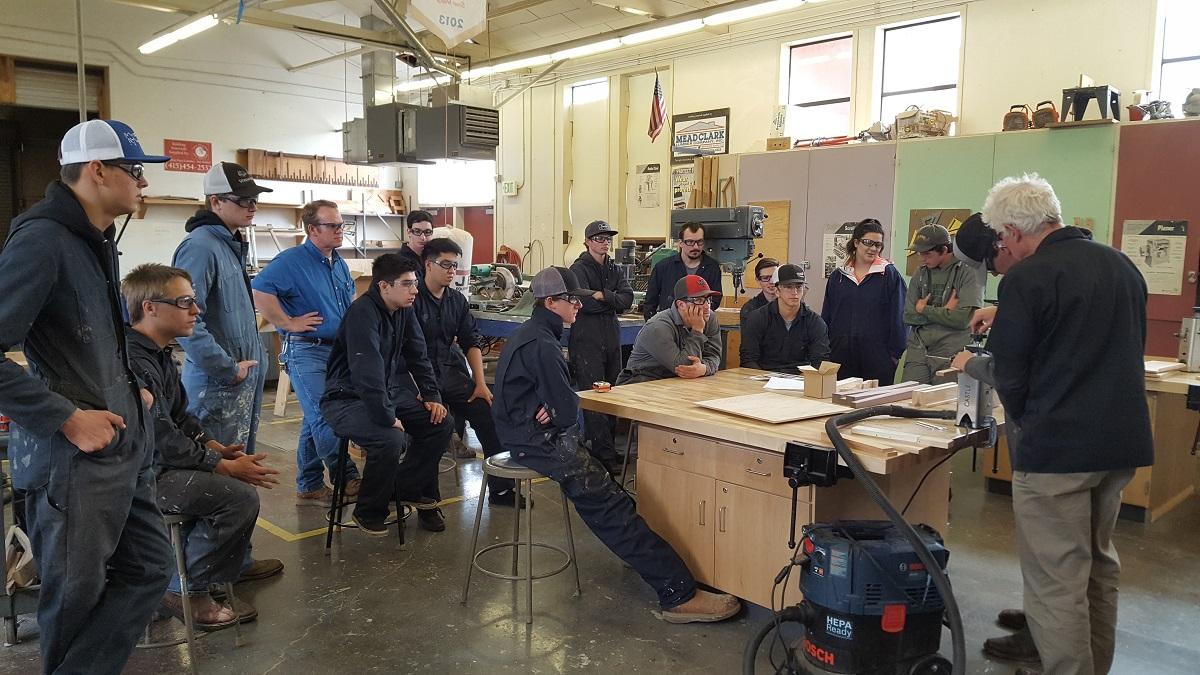
Castle founder Max Durney demonstrates woodworking techniques to students.

Photo By Castle USA

Castle usa PETALUMA, Calif. -- Castle USA, a woodworking machinery manufacturer, has extended the entry period for its student woodworking contest, “What’s Your Angle?” until April 15, 2023.

Will Sampson
Will Sampson

Castle also announced the judging panel participants, which is a literal “Who’s Who” in the woodworking industry. Joining Castle in evaluating entries are:

  • Will Sampson, editorial director, CCI Media/Woodworking Network, FDMC Magazine, Closets & Organized Storage
  • Rob Johnstone, publisher, Woodworker’s Journal
  • Logan Wittmer, editor-in-chief, Popular Woodworking
  • Jim Heavy, master woodworker, Wood Magazine

Entries will be evaluated based on the overall look and presentation of the project as well as the most effective and innovative use of screw pocket joinery. The use of Castle machinery or products is not required.

Winning prizes include the Castle 110 Pocket Cutter, a TSM-12 Pocket Cutting Machine, or the foot-pedal-operated TSM-22 Pocket Cutter. Contest prizes range from $659.99 to $4,899.00.

Entry forms and more detailed information can be found on the Castle USA website.

Contestants will compete in three categories: Individual Student, High School Program/Class, and Secondary or Vo-tech Program/Class.

“We are thrilled to announce our judging panel – each of these guys is so highly respected, not just as editors or publishers, but as highly skilled, expert woodworkers,” said Mathias Forsman, CEO. “Working with such a distinguished panel of judges will help us encourage student woodworkers and provide an incentive for students and educators to learn more about pocket joinery, whether they use our machines or not.”

The World's Largest Collection of 16000 Woodworking Plans!